Northern Pakistan Tour | Explore Hunza, Skardu & Swat

Northern Pakistan offers some of the world’s most breathtaking mountain scenery, ancient cultures, and adventure opportunities that most travelers never experience. This Northern Pakistan Tour guide is perfect for adventure seekers, photography enthusiasts, and cultural explorers who want to discover the country’s most spectacular northern regions without the usual tourist crowds.

Get ready to explore three incredible destinations that showcase Pakistan’s diverse beauty. We’ll take you through the hidden gems of Hunza Valley, where terraced fields meet towering peaks and centuries-old traditions still thrive. You’ll also discover how to navigate the majestic landscapes of Skardu, your gateway to some of the highest mountains on Earth and crystal-clear alpine lakes that look almost too beautiful to be real.

Finally, we’ll show you how to experience the rich cultural tapestry of Swat Valley, where Buddhist heritage meets stunning natural beauty in ways that will completely change how you see this region.

Discover the Hidden Gems of Hunza Valley
Create a clean, professional travel infographic in a full-bleed wide layout with aspect ratio 3:2, using layered Himalayan mountain scenery as a soft background in cool blues, warm sunrise golds, and apricot orange accents. Use modern sans-serif fonts with a bold title at the top center in dark navy.

Top header text:
"Discover the Hidden Gems of Hunza Valley"
Subtitle beneath in smaller text:
"Experience the breathtaking beauty of Karimabad's ancient forts"

Organize the infographic into 4 wide horizontal sections or 2-column blocks with clear numbered markers, icons, and short text captions.

Section 1 on the upper left: "1. Karimabad’s Ancient Forts"
Include two illustrated fort icons/images side by side:
- Baltit Fort with a rocky outcrop, wooden balconies, carved details
- Altit Fort with restored stone architecture and mountain views
Add small label text beside each:
"Baltit Fort — 700 years old"
"Altit Fort — 1,100 years old"
Include a small camera icon and golden-hour sun icon near the forts. Background elements: Karakoram peaks and a river below.

Section 2 on the upper right: "2. Sunrise at Eagle’s Nest"
Show a viewpoint icon on a high mountain ridge with a sunrise over snow peaks. Include three mountain labels with small peak markers:
"Rakaposhi"
"Diran Peak"
"Golden Peak"
Add text:
"2,800 meters above sea level"
"30 minutes from Karimabad"
Use a glowing sunrise palette of gold, pink, and orange. Include a small silhouette of apricot trees in autumn colors at the bottom of this block.

Section 3 on the lower left: "3. Hunza Hospitality"
Show a welcoming local family scene with a guesthouse, shared meal table, and music/dance symbols. Include small icons for a bowl, handshake, and musical note.
Add short text:
"Family-run guesthouses"
"Traditional meals and stories"
"Music, dance, and local crafts"
"Multilingual hospitality"

Section 4 on the lower right: "4. Hunza Apricots & Local Cuisine"
Show a bowl of golden apricots, apricot tree branches, and traditional dishes arranged neatly:
"Chapshoro"
"Harrisa"
"Mamtu"
"Hunza bread"
"Organic local cuisine"
"July–August harvest"
"Traditional stone ovens"
Add small icons for fruit, leaf, bread, steam, and honey jar.

Use clean divider lines, numbered badges in circles, and a balanced grid. Keep text short and readable. Include small decorative motifs inspired by Hunza patterns. Ensure the layout feels wide and spacious, not vertical, with strong visual hierarchy and clear section separation.

Experience the breathtaking beauty of Karimabad’s ancient forts

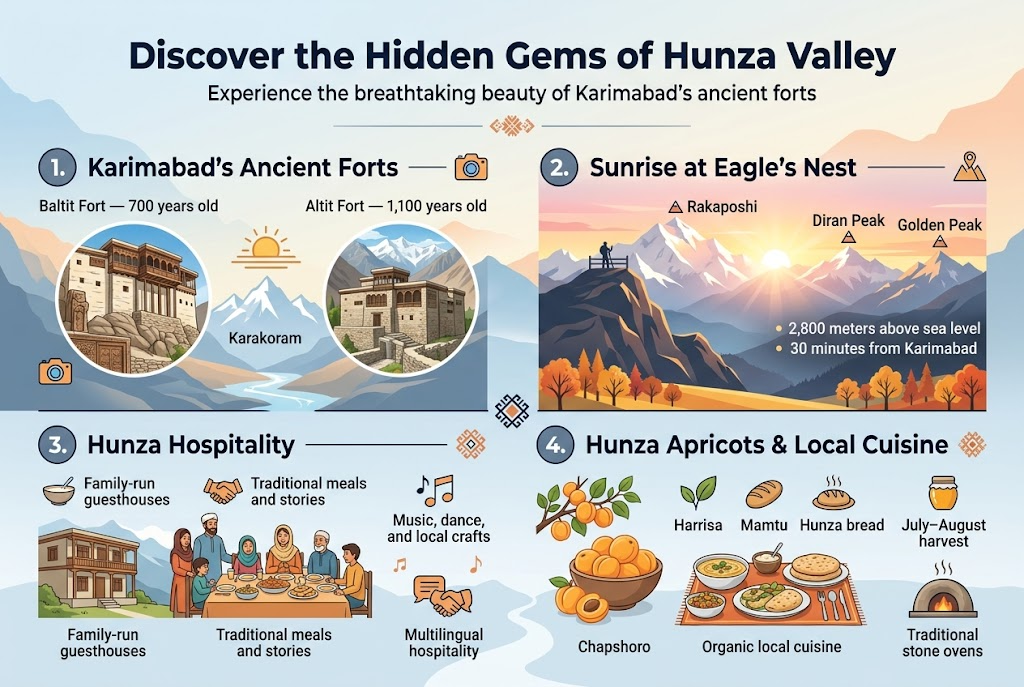
Karimabad stands as the crown jewel of Hunza Valley, where centuries-old fortresses tell stories of a bygone era. Baltit Fort, perched dramatically on a rocky outcrop, offers visitors a glimpse into 700 years of history. The fort’s wooden balconies and intricate carvings showcase the remarkable craftsmanship of ancient Hunza rulers. Walking through its narrow corridors feels like stepping back in time, with each room revealing artifacts and exhibits that bring the past to life.

Just a short walk away, Altit Fort presents an even older testament to Hunza’s rich heritage. This 1,100-year-old structure boasts stunning views of the Karakoram Range and the rushing Hunza River below. The fort’s restoration has preserved its original architectural elements while making it accessible for modern visitors. Both fortresses offer perfect vantage points for photography, especially during golden hour when the surrounding peaks glow with warm light.Northern Pakistan Tour

Witness the magical sunrise at Eagle’s Nest viewpoint

Eagle’s Nest viewpoint delivers one of the most spectacular sunrise experiences in all of Pakistan. Located about 30 minutes from Karimabad, this elevated perch provides unobstructed views of Rakaposhi, Diran Peak, and Golden Peak. The early morning journey rewards visitors with a front-row seat to nature’s daily masterpiece as the sun paints the snow-capped mountains in brilliant shades of gold, pink, and orange.

The viewpoint’s strategic location at 2,800 meters above sea level makes it an ideal spot for capturing the entire Hunza Valley in a single frame. Local guides often share legends about the area while visitors wait for the perfect lighting. The experience becomes even more magical during autumn when apricot trees below display their vibrant colors against the dramatic mountain backdrop.

Explore the legendary hospitality of Hunza people

The warmth of Hunza people creates memories that last long after your Northern Pakistan tour ends. Local families often invite travelers to share traditional meals and stories about their mountain lifestyle. This genuine hospitality isn’t just politeness – it’s deeply rooted in the region’s cultural values and centuries-old traditions of welcoming strangers.

Staying in family-run guesthouses provides authentic cultural exchanges where visitors learn about daily life in this remote mountain community. Locals eagerly share their knowledge about mountain climbing, farming techniques, and traditional crafts. Many speak multiple languages, including English, making communication comfortable for international visitors. Evening gatherings often feature traditional music and dance performances that showcase the rich cultural heritage of the region.

Taste the famous Hunza apricots and organic local cuisine

Hunza’s organic apricots have gained worldwide recognition for their exceptional sweetness and nutritional value. These golden fruits grow naturally in the valley’s pristine environment, free from pesticides and chemicals. During harvest season (July-August), visitors can pick fresh apricots directly from trees while learning about traditional drying and preservation methods.

The local cuisine extends far beyond apricots. Traditional dishes like chapshoro (meat-filled flatbread), harissa (wheat and meat porridge), and mamtu (steamed dumplings) showcase the region’s culinary creativity. Most ingredients come from local organic farms, ensuring freshness and authentic flavors. Hunza bread, baked in traditional stone ovens, pairs perfectly with locally produced honey and dried fruits. Many restaurants and homestays offer cooking classes where visitors can master these time-honored recipes while enjoying breathtaking mountain views.

Unveil the Majestic Landscapes of Skardu
Create a full-bleed professional infographic in a 3:2 aspect ratio with a clean modern travel-editorial style, vivid alpine colors, and strong visual hierarchy. Use a wide horizontal layout with three main side-by-side content sections across the page, plus a bold title bar at the top. Background: subtle panoramic collage of Skardu mountains, glacier, lake, and desert grasslands blended softly behind the sections.

Top title area:
Large bold heading centered at the top in dark navy sans-serif text: "Unveil the Majestic Landscapes of Skardu"
Small subtitle beneath in lighter text: "Alpine lakes • High mountain base camps • Ancient rock carvings"

Main body layout: three wide infographic blocks across the center, each with a numbered badge, a colored header strip, a large icon, and short bullet-style text.

Left section, blue-green themed, header text: "1. Sheosar Lake"
Include a circular lake icon with mirrored mountains, a small trout icon, and a tiny ibex silhouette.
Text bullets:
"4,142 meters above sea level"
"Crystal-clear glacial water"
"Mirror reflections of mountains and clouds"
"Wild brown trout and Himalayan ibex"
"Best for summer camping and stargazing"
Add a small side note badge: "Deosai Plains drive"

Center section, ice-white and slate themed, header text: "2. K2 Base Camps"
Include a mountain icon with three sharp peaks, a trekking boot icon, and a small compass icon.
Text bullets:
"Gateway to K2, Broad Peak, and Gasherbrum"
"K2 Base Camp trek: 12–14 days"
"Concordia: 'Throne Room of the Mountain Gods'"
"Glacial moraines and alpine meadows"
"Guides, porters, permits, and equipment required"
Add a small highlight tag: "High-altitude adventure"

Right section, warm sandstone and gold themed, header text: "3. Manthal Buddha Rock"
Include a carved stone tablet icon, a Buddha relief icon, and a small Silk Road route line icon.
Text bullets:
"Over 1,000 years of history"
"Rock carvings along the Indus River"
"Buddha figure with Sanskrit, Tibetan, and Chinese inscriptions"
"Short hike from the main road"
"Golden hour is best for photography"
Add a small caution tag: "Do not touch carvings"

Bottom strip across the full width:
A slim horizontal footer band with three small illustrated icons and short labels spaced evenly:
"Cold nights" with a crescent moon icon
"Stargazing" with a star cluster icon
"Local guides" with a person-and-map icon

Design details:
Use bold sans-serif typography for headings and clean readable sans-serif for bullets.
Use dark navy text on light backgrounds with accent colors: lake blue, glacier white, alpine green, sandstone gold.
Add subtle map-line accents, mountain contour lines, and small divider arrows between sections.
Keep all text crisp, aligned, and easy to read.
No frame, no border poster, no narrow vertical stacking; use a wide balanced infographic layout.

Marvel at the crystal-clear waters of Sheosar Lake

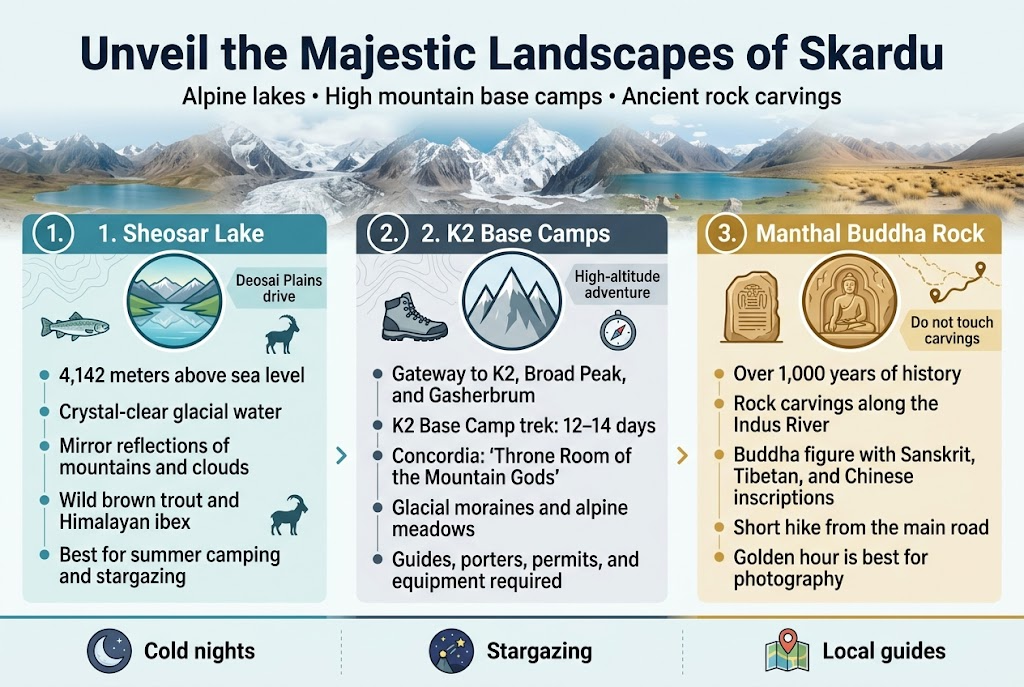
Nestled at an altitude of 4,142 meters, Sheosar Lake stands as one of Pakistan’s most breathtaking alpine lakes. The journey to this pristine gem requires a scenic drive through Deosai Plains, where the vast golden grasslands stretch endlessly toward snow-capped peaks. During summer months, the lake transforms into a mirror reflecting the surrounding mountains and clouds, creating picture-perfect moments that will leave you speechless.Northern Pakistan Tour

The water’s clarity is so remarkable that you can see straight to the bottom, revealing the rocky lakebed beneath. This transparency comes from the lake’s glacial origins and minimal human disturbance. Wild brown trout swim gracefully in these waters, and if you’re lucky, you might spot Himalayan ibex grazing along the shores.

Camping near Sheosar Lake offers an unforgettable experience. The nights are crisp and clear, perfect for stargazing without light pollution. Pack warm clothing as temperatures can drop significantly, even during summer.

Conquer the base camps of world’s highest peaks

Skardu serves as the gateway to some of Earth’s most formidable mountains, including K2, Broad Peak, and Gasherbrum. The region attracts serious mountaineers and trekkers from around the globe, making it a hub for high-altitude adventures. Even if you’re not planning to scale these giants, reaching their base camps offers incredible rewards.

The trek to K2 Base Camp takes approximately 12-14 days and ranks among the world’s most spectacular mountain walks. The route passes through Concordia, often called the “Throne Room of the Mountain Gods,” where four 8,000-meter peaks converge in a dramatic amphitheater of ice and rock.

For those seeking shorter adventures, Broad Peak Base Camp provides excellent acclimatization opportunities and stunning views without the extended commitment. The trail winds through glacial moraines and alpine meadows, offering glimpses of local wildlife including snow leopards and Marco Polo sheep.

Professional guides and porters are essential for these expeditions. Local outfitters in Skardu provide comprehensive packages including permits, equipment, and experienced staff who know the terrain intimately.

Explore the ancient rock carvings at Manthal Buddha Rock

Hidden along the banks of the Indus River, Manthal Buddha Rock preserves centuries of cultural heritage through intricate stone carvings. These petroglyphs date back over 1,000 years and showcase the region’s Buddhist past, when Skardu lay along the ancient Silk Road trade routes.

The main attraction features a large Buddha figure carved directly into the granite cliff face, surrounded by smaller inscriptions in various scripts including Sanskrit, Tibetan, and Chinese. Local legends suggest that ancient travelers and pilgrims created these carvings as offerings for safe passage through the treacherous mountain passesNorthern Pakistan Tour

The site requires a short hike from the main road, following a well-marked trail through terraced fields and traditional Balti villages. Local children often serve as enthusiastic guides, sharing stories passed down through generations about the mysterious figures etched in stone.

Photography enthusiasts will find the best lighting during golden hour, when the low sun creates dramatic shadows across the carved surfaces. Respect for this archaeological treasure is crucial – avoid touching the carvings and stick to designated viewing areas to preserve these irreplaceable artifacts for future generations.

Experience the Cultural Richness of Swat Valley
Create a full-bleed landscape infographic in 3:2 aspect ratio about Swat Valley, with a clean professional travel-editorial style, rich colors, and clear visual hierarchy. Use a wide multi-section layout, not a vertical poster.

Top header across the full width: large bold title in dark green and deep gold, serif or modern sans-serif mix, reading "Experience the Cultural Richness of Swat Valley". Add a smaller subtitle beneath it: "Discover the archaeological treasures of Gandhara civilization". Background behind header: soft illustrated panorama of Swat Valley mountains, green hills, and a faint Buddhist stupa silhouette.

Main body organized into 5 horizontal or grid-style sections with numbered circular icons and short text blocks:

1) Left upper section: "Gandhara Archaeological Treasures" with an icon of a Buddha statue and carved stone relief. Include small visuals of Gandhara sculptures, a museum display, and Greco-Roman decorative details. Text block: "1. Gandhara civilization (1st–5th centuries CE)". Add visual motifs of Greek columns, Roman drapery, Persian patterns, and Buddhist halos.

2) Upper center-right section: "Lush Meadows & Waterfalls" with an icon of a waterfall and wildflower. Show rolling green meadows, bright spring wildflowers, white cascading waterfalls, rocky cliffs, and pine trees. Add labels: "White Palace", "Fizagat Park", "Pristine mountain water".

3) Middle left section: "Pashtun Culture & Crafts" with an icon of woven cloth and a wooden carving tool. Show Pashtun hospitality scene, artisan hands making woodwork, embroidery, and metalwork, plus a colorful market with carpets, jewelry, and wooden crafts. Include text: "Traditional meals", "Warm hospitality", "Handmade souvenirs".

4) Middle right section: "Sacred Buddhist Monasteries & Stupas" with an icon of a stupa and meditation pose. Show ancient stone ruins, monastery walls, quiet pathways, and monks' silhouettes. Include labels: "Takht-i-Bahi style", "Jehanabad", "Nimogram", "Meditation & reflection".

5) Bottom wide section spanning the full width: "Kalam & Mahodand Lakes" with an icon of an emerald lake and snow peak. Show Mahodand Lake with mirror-like emerald water, snow-capped mountains, pine forest road, and small traditional village fields. Add text: "Gateway to alpine lakes", "Scenic mountain drive", "Northern Pakistan Tour".

Use color palette: emerald green, turquoise, warm gold, earthy brown, stone gray, and sky blue. Use thin dividing lines, rounded section cards, and clear numbered markers (1–5) in gold circles. Keep all text readable, modern, and balanced. Include subtle decorative borders with Gandhara-inspired motifs along the edges. No photo collage, no vertical poster layout, no empty white space.

Discover the archaeological treasures of Gandhara civilization

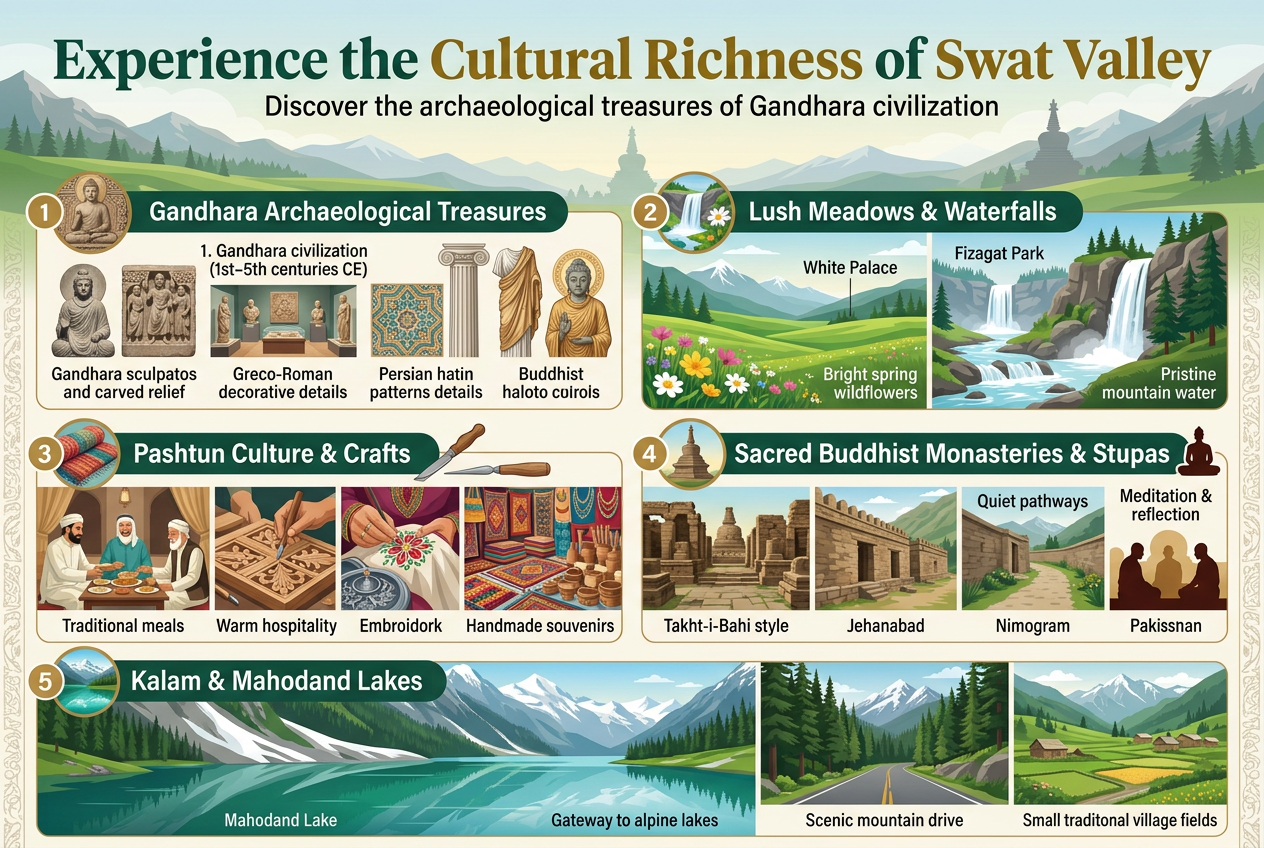
Swat Valley stands as one of the most significant archaeological sites in the world, housing remarkable remnants of the ancient Gandhara civilization that flourished from the 1st to 5th centuries CE. Walking through these historical grounds feels like stepping back in time, where Greek, Roman, Persian, and Buddhist influences merged to create a unique cultural tapestry.

The museum in Saidu Sharif showcases an incredible collection of Gandhara sculptures, including intricately carved Buddha statues and bodhisattva figures that display distinctive Greco-Roman artistic features. These artifacts tell stories of a civilization where trade routes brought together diverse cultures, creating art that blends Eastern spirituality with Western aesthetics.

Enjoy the lush green meadows and pristine waterfalls

Nature lovers find paradise in Swat’s breathtaking landscapes, where rolling green meadows stretch as far as the eye can see. The valley transforms into a carpet of wildflowers during spring and summer, creating picture-perfect scenes that rival any European countryside.

White Palace and Fizagat Park offer stunning viewpoints where visitors can appreciate the valley’s natural beauty. The cascading waterfalls throughout the region provide refreshing breaks during hikes, with crystal-clear mountain water creating natural pools perfect for a quick dip on warm days. Each waterfall has its own character – some thunder down rocky cliffs while others gently cascade over moss-covered stones.

Immerse yourself in traditional Pashtun culture and crafts

The warm hospitality of Swat’s Pashtun communities creates unforgettable cultural exchanges for visitors. Local artisans still practice traditional crafts passed down through generations, including intricate woodwork, embroidery, and metalwork that reflects the region’s rich cultural heritage.

Visiting local homes and participating in traditional meals offers authentic glimpses into Pashtun lifestyle. The famous Pathan code of hospitality ensures every guest feels welcomed and honored. Local markets buzz with activity where you can purchase handmade carpets, traditional jewelry, and wooden crafts that make perfect souvenirs.

Visit the sacred Buddhist monasteries and stupas

Ancient Buddhist sites scattered throughout Swat Valley reveal the region’s spiritual significance as a major center of Buddhist learning. The Takht-i-Bahi monastery complex, though technically in nearby Mardan, represents the architectural style found throughout the region.

Local stupas and monastery ruins in areas like Jehanabad and Nimogram offer quieter, more intimate experiences where you can meditate among centuries-old stone structures. These sites provide perfect opportunities for reflection while imagining the monks who once walked these paths, dedicating their lives to spiritual pursuits.Northern Pakistan Tour

Explore the emerald lakes of Kalam and Mahodand

Kalam serves as the gateway to some of Pakistan’s most stunning alpine lakes, where emerald waters mirror snow-capped peaks in perfect symmetry. Mahodand Lake, accessible by a scenic drive through pine forests, captivates visitors with its otherworldly beauty and serene atmosphere.

The journey to these lakes offers just as much beauty as the destinations themselves. Winding mountain roads pass through traditional villages where locals tend their fields and livestock using methods unchanged for generations. During your Northern Pakistan Tour, these lakes provide some of the most peaceful moments, where the only sounds are gentle lapping water and mountain breezes through the trees.

Master the Art of Northern Pakistan Travel Planning
Aspect ratio 3:2, full-bleed wide infographic illustration, clean professional travel-planning style, modern flat vector design with subtle mountain landscape accents, crisp typography, blue-teal-green-gold color palette with white background sections and colored headers, no border frame.

Top center: large bold title in dark navy text, "Master the Art of Northern Pakistan Travel Planning"

Below title, three wide horizontal content bands arranged left-to-right in a 3-column layout with clear visual hierarchy and simple icons.

LEFT COLUMN: "1. Best Travel Seasons" with a calendar icon and four seasonal blocks.
Include small valley icons for Hunza, Skardu, and Swat.
Text blocks:
"Spring (April-May)"
- "Hunza: blooming apricot trees"
- "Skardu: warming up, some high areas still snowy"
- "Swat: wildflowers and mild weather"

"Summer (June-August)"
- "Hunza: pleasant days, cool nights"
- "Skardu: full access to Deosai Plains and K2 Base Camp"
- "Swat: warm with occasional rain showers"

"Autumn (September-October)"
- "Hunza: famous fall colors"
- "Skardu: crystal-clear mountain views"
- "Swat: comfortable temperatures, fewer crowds"

"Winter (November-March)"
- "Best for Swat"
- "Hunza and Skardu mountain passes usually close"

Use small sun, leaf, snowflake, and flower icons beside each season.

CENTER COLUMN: "2. Transportation Between Valleys" with airplane, road, and 4WD icons.
Add a small route map line with arrows between Islamabad, Hunza, Skardu, Swat.
Text blocks:
"Flying vs. Driving"
- "Islamabad to Skardu flight: 1 hour"
- "Mountain drive: 8 hours"
- "Flights depend on weather"
- "Road travel offers scenic stops"

"Popular Routes"
- "Islamabad → Hunza → Skardu → Islamabad"
- "7-10 days minimum"
- "Islamabad → Swat → Hunza → Skardu"
- "10+ days"
- "Northern loop: all three valleys"
- "14+ days recommended"

"Vehicle Options"
- "4WD vehicles"
- "Local drivers"
- "Motorbike tours"
- "Public transport"

Add small note box at bottom with airplane icon:
"Book flights early"
"Keep backup ground transport plans"

RIGHT COLUMN: "3. Accommodation Choices" with hotel, guesthouse, tent, and heritage-house icons.
Use three stacked pricing cards and one unique-stays card.
Text blocks:
"Budget-Friendly ($15-30/night)"
- "Local guesthouses"
- "Shared facilities"
- "Family-run establishments"
- "Backpackers and cultural enthusiasts"

"Mid-Range Comfort ($40-80/night)"
- "Tourist hotels"
- "Private bathrooms and heating"
- "Restaurant facilities"
- "Balanced comfort and value"

"Luxury Experiences ($100+/night)"
- "Serena Hotels in Hunza and Skardu"
- "Premium valley views"
- "Full-service amenities"
- "Guided tour arrangements"

"Unique Stays"
- "Traditional wooden houses in Kalash villages"
- "Camping near K2 Base Camp"
- "Heritage properties"

Bottom wide footer strip across all columns with suitcase and clock icons:
"Book accommodations early during June-September"
"Many mountain hotels close in winter"
"Family guesthouses offer authentic meals and local tips"

Use strong section headers in bold uppercase, white text on colored bars, clear bullet points, small visual markers, balanced spacing, readable sans-serif font, infographic icons for mountains, road, plane, hotel, calendar, weather, and tents, wide landscape composition, no centered vertical poster layout.

Choose the optimal travel seasons for each destination Northern Pakistan Tour

Planning your Northern Pakistan tour means understanding each region’s unique climate patterns. The golden window for visiting these spectacular valleys runs from April through October, but each destination has its sweet spots.

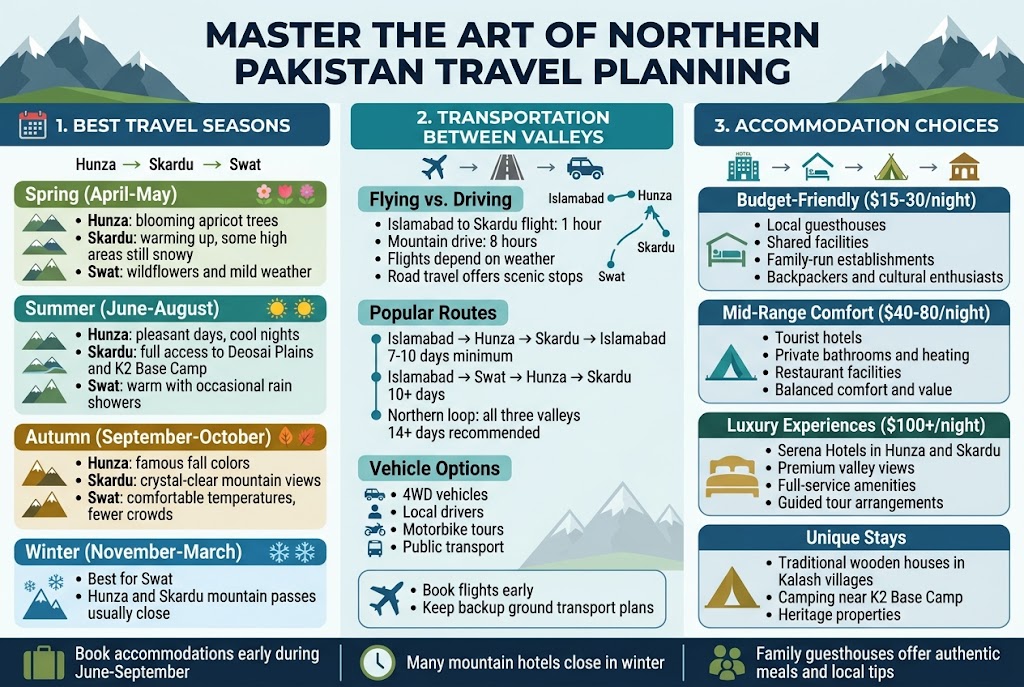
Spring (April-May) brings blooming apricot trees in Hunza and moderate temperatures perfect for trekking. Skardu starts warming up, though some high-altitude areas remain snow-covered. Swat bursts with wildflowers and comfortable weather for exploring.

Summer (June-August) offers the best access to all three regions. Hunza enjoys pleasant days and cool nights, ideal for outdoor activities. Skardu becomes fully accessible with clear roads to Deosai Plains and K2 Base Camp. Swat can get warm but remains manageable with occasional rain showers.

Autumn (September-October) delivers spectacular golden landscapes, especially in Hunza where the famous fall colors paint the valley. Skardu offers crystal-clear mountain views before winter sets in. Swat provides comfortable temperatures and fewer crowds.

Winter visits work best for Swat (November-March) when snow adds magical beauty, though mountain passes to Hunza and Skardu typically close from December through March.Northern Pakistan Tour

Navigate transportation options between valleys

Getting around Northern Pakistan requires strategic planning since these valleys aren’t connected by direct routes. Your transportation choices significantly impact your experience and budget.

Flying vs. Driving Trade-offs:

  • Islamabad to Skardu flights (1 hour) beat the 8-hour mountain drive but depend on weather conditions

  • Flights to Chitral for Swat access save time but limit flexibility

  • Road travel offers scenic beauty and stops at hidden gems

Inter-Valley Connections:
The classic circuit involves flying into one valley and driving between others. Popular routes include:

  • Islamabad → Hunza → Skardu → back to Islamabad (7-10 days minimum)

  • Islamabad → Swat → Hunza → Skardu (requires 10+ days)

  • Northern loop covering all three valleys (14+ days recommended)

Vehicle Options:

  • 4WD vehicles handle rough mountain roads and weather changes

  • Local drivers know shortcuts and weather-related detours

  • Motorbike tours appeal to adventure seekers but require experience

  • Public transport exists but limits scheduling flexibility

Book domestic flights early since PIA’s small aircraft fill quickly during peak season. Keep backup ground transport plans since mountain weather can cancel flights.

Select accommodation that matches your adventure level

Northern Pakistan offers accommodation ranging from basic guesthouses to luxury resorts, each providing different experiences and access levels.

Budget-Friendly Options ($15-30/night):

  • Local guesthouses offer authentic cultural immersion

  • Shared facilities and simple meals keep costs low

  • Family-run establishments provide insider travel tips

  • Perfect for backpackers and cultural enthusiasts

Mid-Range Comfort ($40-80/night):

  • Tourist hotels balance comfort with reasonable pricing

  • Private bathrooms and heating for mountain nights

  • Restaurant facilities reduce meal planning stress

  • Good compromise between budget and comfort

Luxury Experiences ($100+/night):

  • Serena Hotels in Hunza and Skardu offer international standards

  • Premium locations with stunning valley views

  • Full-service amenities including guided tour arrangements

  • Ideal for travelers prioritizing comfort and convenience

Unique Stays:

  • Traditional wooden houses in Kalash villages (Swat region)

  • Camping options near K2 Base Camp (Skardu area)

  • Heritage properties converted from former royal residences Northern Pakistan Tour

Book accommodations well in advance during peak season (June-September) since quality options fill quickly. Many mountain hotels close during winter months, limiting choices significantly. Consider staying in family guesthouses for authentic experiences and home-cooked meals featuring local specialties.

Capture Instagram-Worthy Moments and Memories
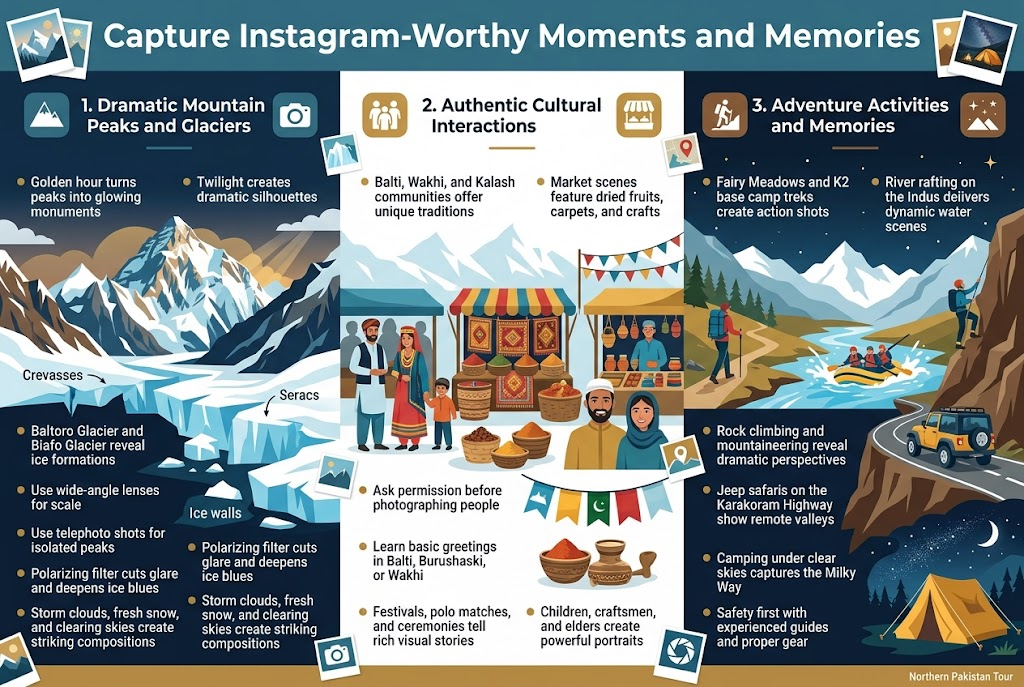
Create a full-bleed professional infographic in 3:2 aspect ratio with a clean modern travel design, bold sans-serif typography, rich alpine color palette of deep navy, glacier blue, white, warm gold, and earthy brown. Place a large bold title across the top: "Capture Instagram-Worthy Moments and Memories". Use a wide horizontal layout with three main numbered sections arranged left to right, each in a distinct color block with icons and short bullet points. Add subtle mountain textures, glacier shapes, and travel photography accents in the background. Use crisp flat-vector illustration style with high contrast and clear visual hierarchy.

SECTION 1 on the left: "1. Dramatic Mountain Peaks and Glaciers"
Include a mountain icon, a glacier icon, and a camera icon. Show towering peaks, snowy ridgelines, and blue glacier ice. Add short bullet text:
"Golden hour turns peaks into glowing monuments"
"Twilight creates dramatic silhouettes"
"Baltoro Glacier and Biafo Glacier reveal ice formations"
"Use wide-angle lenses for scale"
"Use telephoto shots for isolated peaks"
"Polarizing filter cuts glare and deepens ice blues"
"Storm clouds, fresh snow, and clearing skies create striking compositions"
Use small visual markers for crevasses, seracs, ice walls, clouds, and sun rays.

SECTION 2 in the center: "2. Authentic Cultural Interactions"
Include a people icon, market icon, and festival icon. Show local communities, colorful market stalls, carpets, spices, and smiling people. Add short bullet text:
"Balti, Wakhi, and Kalash communities offer unique traditions"
"Market scenes feature dried fruits, carpets, and crafts"
"Ask permission before photographing people"
"Learn basic greetings in Balti, Burushaski, or Wakhi"
"Festivals, polo matches, and ceremonies tell rich visual stories"
"Children, craftsmen, and elders create powerful portraits"
Use visual symbols for cultural clothing, spice baskets, handcrafted goods, and festival flags.

SECTION 3 on the right: "3. Adventure Activities and Memories"
Include an adventure icon, trekking icon, rafting icon, and starry sky icon. Show a trekking trail, rafting river, climbing cliff, jeep on mountain road, and a camping tent under the Milky Way. Add short bullet text:
"Fairy Meadows and K2 base camp treks create action shots"
"River rafting on the Indus delivers dynamic water scenes"
"Rock climbing and mountaineering reveal dramatic perspectives"
"Jeep safaris on the Karakoram Highway show remote valleys"
"Camping under clear skies captures the Milky Way"
"Safety first with experienced guides and proper gear"
Use strong motion lines, splashing water, steep cliffs, winding roads, and stars.

Place small decorative photo-frame icons, map pins, and camera shutter symbols between sections. Keep all text sharp, legible, and neatly aligned. Use white text on dark panels and dark text on light panels. Add a subtle bottom strip with small text: "Northern Pakistan Tour". No inset margins, no poster frame, no crowded vertical stack.

Photograph the dramatic mountain peaks and glaciers

The towering peaks of northern Pakistan create some of the most breathtaking photo opportunities on Earth. K2, Nanga Parbat, and the Karakoram range provide dramatic backdrops that make every shot look professional. Early morning golden hour transforms these giants into glowing monuments, while the deep blue twilight creates silhouettes that capture the raw power of these mountains.

Baltoro Glacier and Biafo Glacier offer incredible ice formations that change throughout the day. The crevasses, seracs, and ice walls create abstract patterns perfect for close-up photography. Pack a polarizing filter to cut through the intense glare and bring out the deep blues hidden in the ice. Wide-angle lenses capture the massive scale, while telephoto shots isolate specific peaks against dramatic cloud formations.Northern Pakistan Tour

Weather changes rapidly in these high-altitude environments, creating unique lighting conditions. Storm clouds rolling over peaks, fresh snow dusting, and clearing skies after rainfall all provide distinctive photographic moments. The contrast between dark rocky faces and pristine white snow creates striking compositions that showcase the raw beauty of Pakistan’s northern frontier.

Document authentic cultural interactions with locals

Northern Pakistan’s diverse communities offer incredible opportunities to capture genuine human connections. The Balti people of Skardu, Wakhi communities in Hunza, and Kalash people of Chitral each have unique traditions, clothing, and customs that tell compelling visual stories.

Local markets buzz with activity and color. Vendors selling dried fruits, handwoven carpets, and traditional crafts create vibrant scenes. The spice markets in particular offer rich textures and warm colors that photograph beautifully. Always ask permission before photographing people, and consider learning basic greetings in local languages like Balti, Burushaski, or Wakhi.

Traditional festivals and celebrations provide incredible documentary opportunities. Polo matches in Shandur Pass, harvest festivals in Hunza, and religious ceremonies showcase authentic cultural practices. These events offer glimpses into centuries-old traditions that remain unchanged by modern influences.Northern Pakistan Tour

Children often make wonderful subjects, with their natural curiosity and bright smiles. Elderly craftsmen working on traditional items like carpets or wooden carvings tell stories of generations through their weathered hands and focused expressions.

Create lasting memories through adventure activities

Adventure photography in northern Pakistan requires preparation but delivers incredible results. Trekking routes like the Fairy Meadows trail to Nanga Parbat base camp or the challenging K2 base camp trek provide countless action shots and landscape opportunities.

River rafting on the Indus River creates dynamic water action shots. The splash of white water against dramatic canyon walls makes for exciting compositions. Waterproof camera housings are essential for getting close to the action without damaging equipment.

Rock climbing and mountaineering expeditions offer unique perspectives impossible to achieve otherwise. Shots from climbing routes showcase the scale and challenge of these massive rock faces. Safety always comes first, so work with experienced guides who understand both climbing and photography needs.

Jeep safaris along the Karakoram Highway provide access to remote valleys and high-altitude lakes. The journey itself becomes part of the adventure story, with dusty mountain roads, precarious bridges, and stunning valley views creating a complete narrative of the Northern Pakistan Tour experience.

Camping under star-filled skies provides opportunities for astrophotography that’s impossible in light-polluted areas. The clear mountain air and minimal light pollution create perfect conditions for capturing the Milky Way above these ancient peaks.

Conclusion
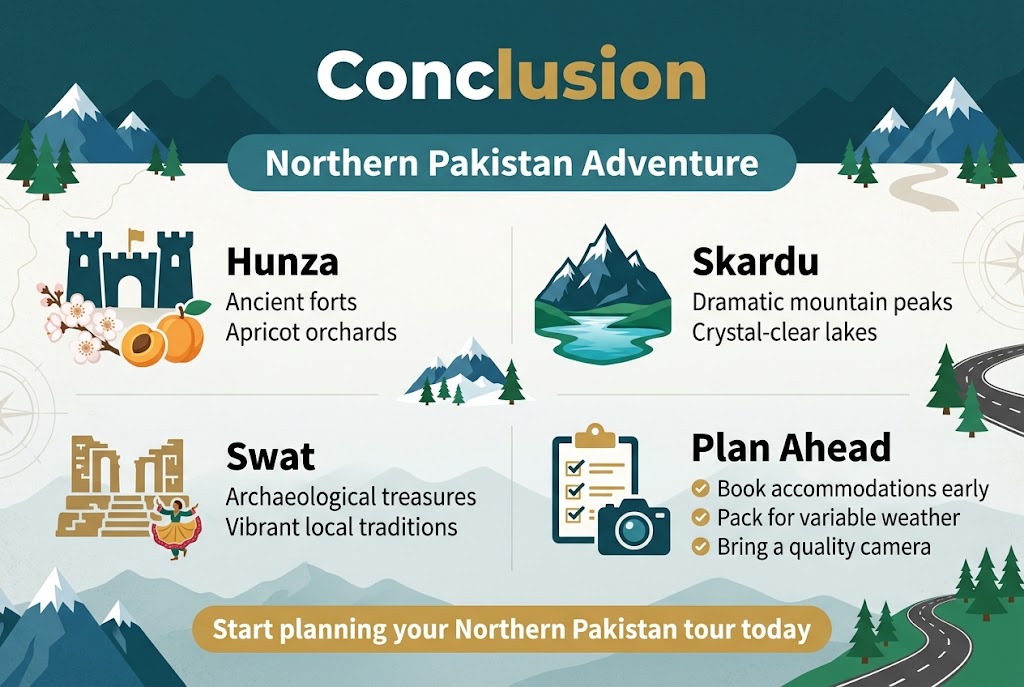
3:2 wide full-bleed infographic illustration, clean professional travel brochure style, modern sans-serif fonts, rich alpine color palette of deep teal, mountain blue, emerald green, warm gold, and white, subtle textured background with layered mountains and faint map خطوط, no frame, no inset margins.

Top center: large bold heading in white and gold, exact text: "Conclusion"

Below the heading, a wide horizontal subheading banner with exact text: "Northern Pakistan Adventure"

Main layout: four balanced content blocks across a wide two-row grid, each with a clear icon, bold section title, and short body text.

Left top block: a stylized fort icon beside a cluster of apricot blossoms and apricot fruit, with the title in bold: "Hunza" and body text: "Ancient forts" on one line and "Apricot orchards" on the next line.

Right top block: a dramatic mountain peak icon above a crystal-clear lake icon, with the title in bold: "Skardu" and body text: "Dramatic mountain peaks" on one line and "Crystal-clear lakes" on the next line.

Left bottom block: an archaeological ruins icon with a small cultural dance motif, with the title in bold: "Swat" and body text: "Archaeological treasures" on one line and "Vibrant local traditions" on the next line.

Right bottom block: a planning checklist icon and camera icon, with the title in bold: "Plan Ahead" and body text in three bullet points with small checkmarks: "Book accommodations early" "Pack for variable weather" "Bring a quality camera"

Bottom center, prominent call-to-action in gold text inside a rounded banner: "Start planning your Northern Pakistan tour today"

Add small decorative elements of snow-capped peaks, pine trees, winding road, and subtle compass lines around the sections, keeping the layout open and balanced, with strong visual hierarchy and crisp legible text.
Northern Pakistan’s breathtaking landscapes and rich cultural heritage make it one of the world’s most rewarding travel destinations. From Hunza’s ancient forts and apricot orchards to Skardu’s dramatic mountain peaks and crystal-clear lakes, each valley offers its own unique charm. Swat’s archaeological treasures and vibrant local traditions add another layer of depth to your journey, creating memories that last a lifetime.

Planning your Northern Pakistan adventure requires some preparation, but the effort pays off tremendously. Book your accommodations early, pack for variable weather conditions, and don’t forget to bring a quality camera to capture those jaw-dropping views. Start planning your Northern Pakistan tour today and get ready to explore some of the most spectacular and unspoiled landscapes on Earth.

learn more about this article  then vist  wikipedia 

want to read more article then check this 

Comments

Popular posts from this blog

Long Distance Car Lift UAE – Safe & Reliable Intercity Travel

Monthly CarLift Service in UAE | Save More, Travel Daily